Compliance in 60 seconds, signal or not.

An offline-first mobile app for waste carriers, built for the October 2027 digital waste tracking mandate.

wastetrace.co.uk
WasteTrace app screenshot

The problem

From October 2027, digital waste tracking becomes the law for waste carriers. Paper transfer notes and glovebox dockets stop being enough, and every waste movement has to exist as a digital record.

The firms this lands hardest on are the smallest ones. Owner-operators and small fleets run on diaries, paper and spreadsheets, and the work itself happens in a cab, at a yard, or at a transfer station - frequently with no signal at all. Compliance software in this space largely assumes a desk, an office and a connection. None of those are present at the moment a load actually changes hands.

The other constraint was adoption. A driver is not going to re-key a day's collections in the evening, and an office is not going to migrate off software that already works. Anything that added admin instead of removing it was never going to be used.

What we built

Offline-first capture

A complete waste record - photo, waste codes, signature, GPS - captured in the cab in under a minute, with no connection required. Records are durable on the device and sync when the vehicle is back in coverage.

Cross-platform mobile app

iOS and Android from a single codebase, built in Expo and TypeScript. One product, one release cycle, no feature drift between platforms.

Duty-of-care vault

Every collection stored with its photo, signature, GPS and waste tracking ID, and searchable after the fact. No shoebox of faded dockets to dig through.

Audit packs on demand

When the Environment Agency asks where a load went, a full audit pack exports in minutes rather than days.

Submission-ready records

Records are structured to the digital waste tracking requirements at the point of capture, so nothing has to be reconstructed or re-entered later.

Office status board

An office-side view of what has been captured, what is still outstanding, and which vehicles have yet to sync.

Companion, not a replacement

No migration and no double-keying. The diary, spreadsheet or office software a firm already runs keeps working exactly as it does now; WasteTrace handles the waste records alongside it.

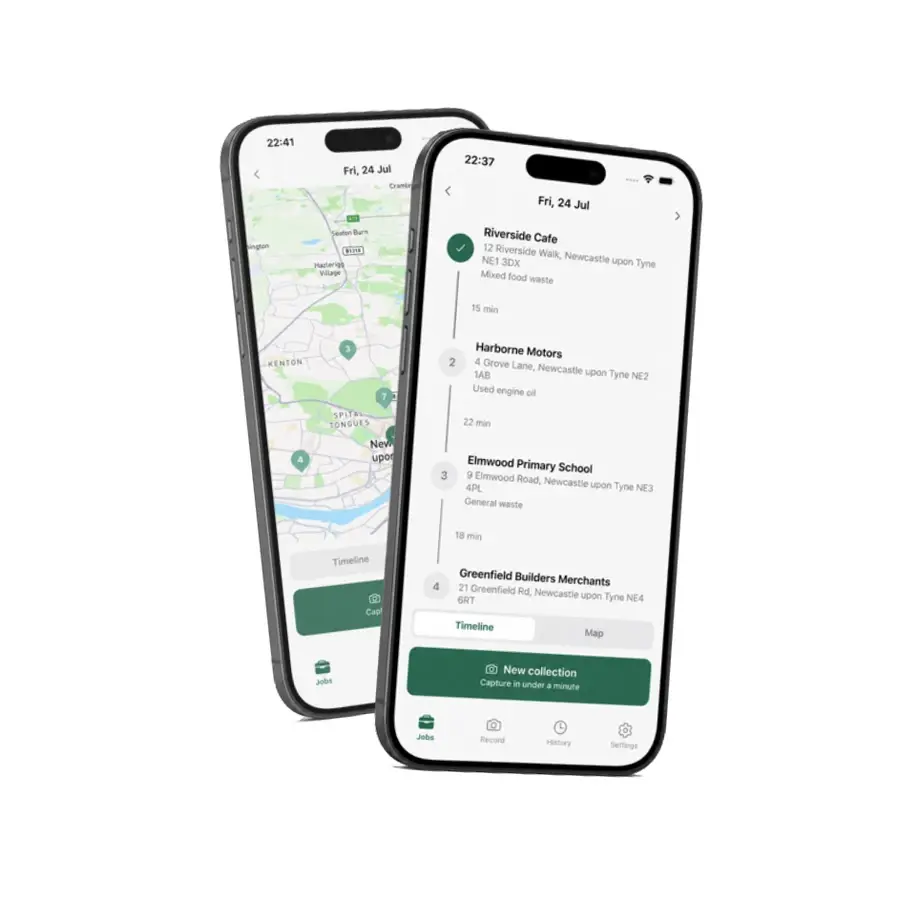
WasteTrace mobile app - the driver's collection timeline and route map for the day

The challenge worth mentioning

Offline-first is the product, not a feature bolted onto it - and it is the part most tools in this space don't offer.

The distinction matters because offline changes the data model rather than the UI. A record created in a cab with no signal has to be durable immediately, hold its own identity, and survive the app being closed or the phone dying. When several vehicles come back into coverage hours later and sync at once, those records have to reconcile into a single ordered account of the day without duplicating, overwriting each other, or quietly losing a signature or photo. That means idempotent sync, local-first storage and queued media upload designed in from the start; retrofitting it onto a connected app is close to a rewrite.

Most competitors assume connectivity because assuming it is far simpler. The problem is that carriers work precisely where it isn't - rural pickups, yards, transfer stations, industrial units. A compliance tool that fails at the moment of capture is worse than useless, because the record it was supposed to create is the legal one.

The second constraint was building against a deadline that is fixed while the detail around it is still settling. That pushed the architecture towards keeping capture and submission separate, so the record structure can move with the regulation without touching how drivers use the app.

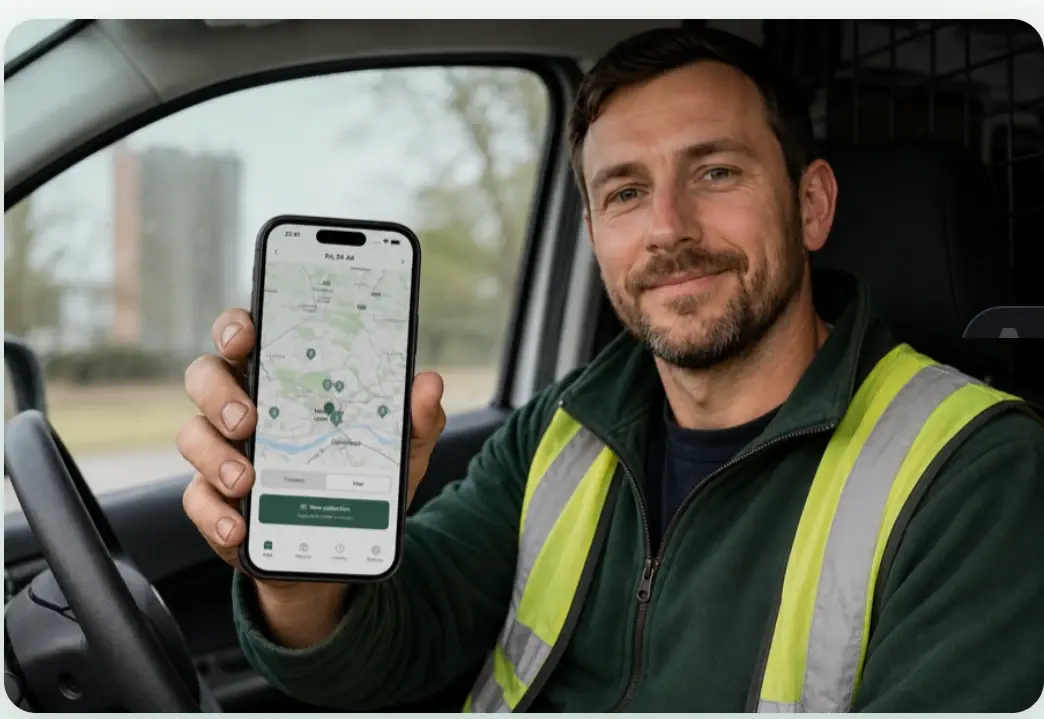
A waste carrier capturing a collection on the WasteTrace app from the cab

Where it is now

In beta with early-access carriers, running real collections ahead of the October 2027 deadline. The current focus is time-in-cab: how few seconds a compliant record can take when the driver has a customer waiting and one hand free.

The record created at the roadside is the legal one. If the app needs a signal to create it, it has failed at the only moment that counts.

- SurgoTech Solutions

iOS appAndroid appMarketing WebsiteOffline-first syncAWS

Building a product that has to work where the connection doesn't?

Start the conversation

Other work

AnFiTestOttiLureAi

Contact Us

Less than icon
Greater than icon

Jack@SurgoTechSolutions.co.uk

+44 7342 628698

SurgoTech S mark

Jack@SurgoTechSolutions.co.uk

+44 7342 628698

©2026 SurgoTech Solutions | All rights reserved | Newcastle upon Tyne, UK | Privacy Policy